Get cited by AI in six weeks: Answer engine optimization for marketers

Answer engine optimization (AEO) is the practice of shaping content so AI systems like ChatGPT, Google’s AI Overviews, and Perplexity can lift it straight into their answers. The point isn’t ranking; it’s being the source those systems quote, cite, or paraphrase. Get this right and you show up inside the answer itself, not just on a results page nobody scrolls past any more.
TL;DR:
- Creating clear, self-contained answer blocks of 40 to 60 words immediately after headings significantly improves the likelihood of being directly quoted by AI answer systems.
- Writing headings as questions and ensuring each section can stand alone helps AI understand and extract your content accurately for citation.
- Valid HTML and validated schema markup, along with fast load times and proper crawlability, are essential technical foundations for effective answer engine optimization.
- Consistent terminology and plain language across all content boost clarity for both AI models and human readers, increasing the chances of being cited in responses.
- Prioritizing straightforward, factual answers over vague marketing language and regularly auditing your content’s citations and mentions are key to sustained AEO success.
Table of Contents
- What is answer engine optimization and why does it matter?
- AEO vs SEO: what changes and what still matters
- Core AEO tactics checklist: what to change on the page
- Can AI actually find and read your content?
- Measuring AEO: metrics that mean something
- A 6-week starter plan with concrete tasks and owners
- Common mistakes and how to avoid them
- How Basic-bs puts AEO into practice for small businesses
- How is voice search changing answer engine optimization?
- Why does user intent shape how you write for AEO?
- How do AI and natural language processing shape AEO?
- What does successful AEO implementation actually look like?
- What’s next for answer engine optimization?
- The honest take on AEO
- Get your site built for AI search from day one
- Sources
- FAQ
What is answer engine optimization and why does it matter?
Answer engines are the tools people now ask instead of Googling: ChatGPT, Perplexity, Google’s AI Overviews, and voice assistants like Siri or Alexa. AEO is the discipline of making your content the thing those systems pull from when they build a response.
The shift is from clicks to inclusion. Traditional SEO chased a top-ten spot on a results page. AEO chases a mention inside the answer itself, whether or not the reader ever clicks through. PwC frames this as a move from ranking to response relevance, arguing that brands now need content that’s easy for AI to find, lift, and reuse without distortion.
That matters because being cited pays off disproportionately well. Research cited in Forbes found AI-driven experiences can convert up to nine times better than traffic from traditional organic search.
Pro Tip: Nine times the conversion rate isn’t about volume, it’s about intent. Someone reading an AI-generated answer that names your business has already had their question half-answered by you before they’ve even landed on your site.
Fewer clicks doesn’t mean fewer opportunities. It means the opportunity moves upstream, into the answer text itself, and that’s exactly where AEO operates.
AEO vs SEO: what changes and what still matters
SEO and AEO chase different prizes, but one doesn’t replace the other. SEO wants a ranking; AEO wants a citation. SEO measures clicks and position; AEO measures mentions, share of answer, and referral quality from AI platforms.
What carries over from SEO:
- Crawlability and clean site architecture still decide whether anything gets seen at all.
- Topical depth still builds the authority that makes an engine trust your page as a source.
- Backlinks and third-party mentions still signal credibility, now to algorithms deciding who to quote.
What AEO adds on top:
- Direct answer blocks written to be lifted verbatim.
- Schema markup that labels your content in a language machines understand.
- Consistent terminology and facts across every channel you publish on, because AI systems cross-reference.
For CMS workflows, this means content teams need an extra editing pass. It isn’t enough to write a good article; someone has to check whether the first paragraph under each heading could stand alone as an answer. Hybrid strategies that keep SEO fundamentals while layering AEO tactics on top tend to be the most resilient, because AEO drives the zero-click visibility while SEO still sustains long-form traffic and conversions.
Core AEO tactics checklist: what to change on the page
Here’s the practical bit. Cut the theory, and this is what actually needs to change on a page:
- Add a direct answer block. Immediately after any H2 or H3, write a self-contained answer of 40 to 60 words. HubSpot recommends a concise direct answer block optimized for AI-generated summaries. because it fits neatly into an AI-generated summary without truncation.
- Phrase headings as questions. “What is X?” gets lifted far more readily than “Understanding X,” because it mirrors how people actually prompt AI systems.
- Make every section self-contained. A reader (or a crawler) should get the full point from that one section, without needing the paragraph before it.
- Use scannable formats. Bullets, numbered steps, and short tables extract more cleanly than dense prose blocks.
- Keep entity names and terminology consistent. If you call it “AEO” in one place and “answer optimisation” in another, you’re making the machine work harder to connect the dots.
- Add FAQPage and HowTo schema. Schema gives AI crawlers a machine-readable map of your content, and structured data plus visible author metadata materially increases extractability.
Pro Tip: Write the direct answer block last, after you’ve drafted the rest of the section. It’s far easier to compress an idea into 50 words once you already know exactly what you’re trying to say.
None of this is exotic. It’s disciplined writing married to a bit of technical housekeeping, and most sites are doing neither.
Can AI actually find and read your content?
None of the tactics above matter if the answer engine can’t retrieve the page in the first place. Retrievability is the unglamorous half of AEO, and it’s where most sites quietly fail.
- Keep critical answers in plain HTML. If your direct answer block only renders after JavaScript fires, plenty of AI crawlers will never see it.
- Check robots.txt and llms.txt. It’s alarmingly common to find a site accidentally blocking the exact crawlers it’s trying to court.
- Prioritise page speed and mobile performance. A slow page gets skipped in favour of a faster competitor with a similar answer.
- Validate your schema. Use a structured data testing tool against schema.org’s specifications before you assume your FAQPage markup is actually working.
The stakes here are rising fast. Pew Research found that users are already less likely to click a link when an AI summary appears above the results. If the crawler can’t read your page, that summary gets built from someone else’s content instead of yours.
Measuring AEO: metrics that mean something
Clicks won’t tell you if AEO is working, because the whole point is that people might never click. You need a different scoreboard.
- Mentions. How often does your brand or content appear when you run a set of prompts across ChatGPT, Perplexity, and Gemini? Running a targeted prompt set weekly gives you a consistent baseline.
- Citation rate. Of those mentions, how many come with an actual link or named attribution back to you, rather than a vague paraphrase?
- Share of answer. When multiple sources could answer a query, what proportion of the answer’s substance traces back to your content?
- AI referral traffic. Segment your analytics to isolate visits arriving from AI platforms specifically, separate from organic search.
A rise in mentions without a rise in citations usually means your content is useful but not distinctive enough to be named. Tie every one of these metrics back to engagement and conversion on the pages people do land on, or you’re just admiring a vanity number.
A 6-week starter plan with concrete tasks and owners
You don’t need a quarter-long overhaul to get moving. Here’s a six-week sprint that gets the fundamentals in place.
- Week 1, audit (content owner). Run your top 20 pages through a prompt set on two or three answer engines. Note what gets cited and what gets ignored.
- Week 2, rewrite answer blocks (content owner). Add 40 to 60 word direct answers under your highest-value headings first.
- Week 3, technical fixes (dev). Confirm answer content renders in raw HTML, check robots.txt and llms.txt, and fix any glaring speed issues.
- Week 4, schema rollout (dev, with content sign-off). Add FAQPage and HowTo schema to the pages rewritten in week two, then validate every markup.
- Week 5, citation outreach (comms). Pitch your best data or insight to industry sites and forums where a third-party citation compounds your visibility elsewhere.
- Week 6, measurement (content owner). Re-run the week one prompt set, compare mentions and citation rate, and report back.
Pro Tip: Start with the pages that already drive revenue or leads. A five-year-old blog post gets less priority than the service page your business actually depends on.
Prioritise low-risk pages first if you’re nervous about schema errors; a product FAQ is a safer testbed than your homepage.
Common mistakes and how to avoid them
Most AEO failures come from four avoidable habits.
- Treating AEO as a replacement for SEO. It’s an addition, not a swap. Drop your SEO fundamentals and you’ll lose the organic traffic that still pays most of the bills.
- Over-optimising the phrasing at the expense of accuracy. A punchy 45-word answer that’s slightly wrong will get you cited and then quietly distrusted.
- Hiding facts behind scripts or paywalls. If the answer engine can’t read it, it doesn’t exist to the algorithm, no matter how good the content is.
- Chasing mentions with no link to outcomes. Structured, extractable answers and third-party citations compound visibility over time, but only if you’re tracking whether those mentions ever turn into engagement.
How Basic-bs puts AEO into practice for small businesses
Talking about AEO in the abstract is easy. Doing it inside a live website build for a small business, on a tight budget, is the actual challenge, and it’s the bit most agencies skip.
Some providers build this in from the start rather than bolting it on later. Sites can go live quickly, and plans may include AI training baked into the site structure from day one, rather than as an add-on months down the line. This approach can mean schema markup, answer blocks, and technical fixes aren’t separate projects to budget for.
The mapping is direct: fast turnaround means fast rewrite cycles when a prompt audit shows a page underperforming; managed UK hosting and SEO means the technical retrievability checks aren’t left to chance; monthly updates mean your answer blocks don’t go stale.
How is voice search changing answer engine optimization?
Voice search compresses everything AEO already demands. When someone asks Alexa or Siri a question, the assistant reads out one answer, not a list of ten blue links, and that answer nearly always comes from a single extracted passage.
This raises the stakes on the direct answer block tactic covered earlier. A 40 to 60 word answer that reads well on a screen also needs to read well out loud, in full sentences, without relying on a bullet list or a table the assistant can’t verbalise. Voice queries also skew more conversational than typed ones. People ask “what’s the best way to fix a leaking tap” rather than typing “tap leak fix,” and content written to match that spoken phrasing has a real edge.
Local intent plays a bigger role here too. A huge share of voice queries carry local or immediate intent, “near me,” “open now,” “how much does X cost,” which rewards businesses that keep their structured data (opening hours, pricing, location) accurate and machine-readable. A small business with a well-tagged FAQ page has a genuine shot at being the answer read aloud, competing on clarity rather than budget.
Voice search doesn’t need a separate strategy from AEO. It needs the same tactics, written with a slightly stronger ear for how the answer sounds when it’s spoken rather than read.
Why does user intent shape how you write for AEO?
Answer engines don’t rank pages, they interpret questions, and that changes what “good content” means. Getting AEO right depends on matching the actual phrasing and underlying intent behind a query, not just the topic.
There’s a meaningful difference between informational intent (“what is answer engine optimization”), comparative intent (“AEO vs SEO”), and transactional intent (“best answer engine optimization tool”). Each deserves a different structure. An informational query wants a tight definition up front. A comparative query wants a clear side-by-side of what changes and what doesn’t. A transactional query wants a direct recommendation with a reason attached.
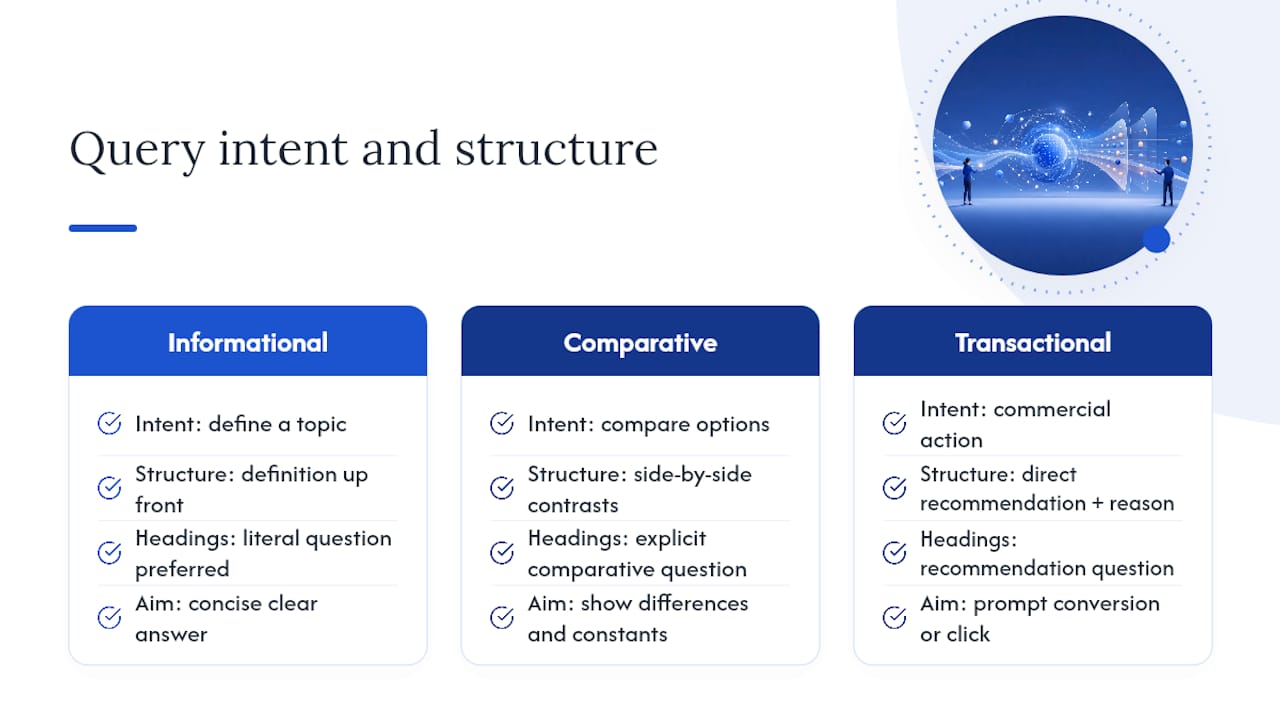
Question phrasing matters more than most content teams assume. Headings written as literal questions, matching how people actually type or speak into an AI system, get lifted into answers far more reliably than clever, descriptive headers. “How Do I Choose Between AEO and SEO?” beats “Choosing Your Optimisation Strategy” almost every time, because it’s the shape of the question the engine is already trying to answer.
This is where a lot of content strategy still lags behind. Writers trained for years to avoid “boring” question-based headings in favour of something punchier are now working against the exact pattern that gets content cited. The fix isn’t complicated. It just requires letting go of a stylistic habit that made sense for a different search era.
How do AI and natural language processing shape AEO?
Natural language processing is the technology deciding whether your content gets understood correctly or misread entirely. Large language models don’t scan for keywords the way older search engines did; they parse meaning, relationships between entities, and context across an entire page.
This is why entity clarity matters so much in AEO. If your page refers to the same concept using three different terms, “answer engine optimization,” “AI search optimisation,” “generative answer strategy,” without ever tying them together explicitly, an NLP model may fail to connect them as the same subject. Consistency across a page, and ideally across your whole site, helps the model build a confident, accurate map of what you’re actually an authority on.
NLP models also weigh structure, not just words. A page with clear headings, short paragraphs, and answer blocks positioned right where a question would naturally sit gives the model an easier extraction path than a wall of unbroken prose making the same point. That’s part of why tools that structure on-site content into direct question-and-answer formats have gained traction. They’re solving the same extraction problem AEO addresses, just at the interface level rather than the content level.
The practical takeaway is that writing for AEO and writing for NLP comprehension are the same task. Write plainly, name things consistently, and structure content so meaning is obvious without requiring inference, and both a human reader and an AI model land on the same understanding.
What does successful AEO implementation actually look like?
The clearest examples of AEO working share a common trait: a specific claim, expressed simply, sitting right where the question would naturally be asked. A business FAQ page that states an exact price or delivery timeframe in a direct sentence tends to get lifted into an AI answer far more reliably than a marketing paragraph that dances around the same fact for three sentences before saying it.
Practitioner audits show a consistent pattern behind the pages that get cited repeatedly: structured, extractable answers combined with cross-domain citations compound visibility over time. A page that answers a question cleanly, and then gets referenced by other sites discussing the same topic, builds a kind of credibility that a single well-optimised page can’t achieve alone. The citation from elsewhere acts as a second signal confirming the answer is trustworthy.
This shows up at a small scale too. A local business page that states its hours, pricing, and service area in plain, structured sentences, backed by FAQPage schema, competes on the same footing as a much larger site for a local voice or AI query. Scale doesn’t decide who gets cited; clarity does.
The common failure mode in unsuccessful attempts is the opposite: pages that bury a genuinely useful answer inside marketing language, forcing the reader (and the crawler) to dig for the actual fact. AEO rewards saying the true thing plainly, first, before saying anything else.
What’s next for answer engine optimization?
The technology behind answer engines is moving fast enough that today’s checklist will need revisiting within a year or two. A few shifts are already visible.
Multimodal retrieval is expanding. AI systems increasingly pull answers from images, video transcripts, and audio, not just text, which means alt text, video captions, and transcript accuracy are becoming AEO factors in their own right, not accessibility afterthoughts.
Personalised answers are growing more common too. As assistants retain more context about a user’s location, past queries, and preferences, the “one correct answer for everyone” model is fading, replaced by answers tailored to context, which makes broad, adaptable content more valuable than narrowly targeted copy.
Agentic AI, systems that don’t just answer a question but take an action on the reader’s behalf (booking, comparing, purchasing), is the biggest looming shift. That raises the bar from “be quoted” to “be transactable,” meaning structured pricing, availability, and booking data will matter as much as prose quality.
None of this makes today’s fundamentals obsolete. Clean HTML, accurate schema, and answer-first structure are the foundation every future development builds on top of, not a phase to skip past.
The honest take on AEO
Most AEO advice floating around treats it as a bolt-on skill, a checklist to run through once a quarter. That’s the wrong instinct. The businesses getting cited consistently are the ones that treat clear, honest writing as the core discipline and schema as the delivery mechanism, not the other way round.
The conventional advice overweights the technical layer. Yes, validate your schema and fix your robots.txt. But I’d argue the bigger failure across most small business sites isn’t technical, it’s that nobody has actually written the 50-word answer to the question their customers are asking. You can have flawless FAQPage markup wrapped around a vague, hedging paragraph, and the AI will still skip past it for a competitor’s plainer sentence.
What should you prioritise first? Not the schema. The sentence. Write the direct, checkable answer first, in plain language, then worry about the markup that helps a machine find it. Get that order backwards and you’ll spend a fortnight validating structured data around content that says nothing worth quoting.
— Conor
Get your site built for AI search from day one
Most small businesses trying to fix this themselves end up choosing between two bad options: an expensive agency retainer to “do AEO,” or months spent learning schema markup and crawler behaviour on evenings and weekends. Some services offer a middle ground, building websites with AI training and answer-ready structures from the outset, so the tactics aren’t retrofitted onto sites that weren’t designed for them.
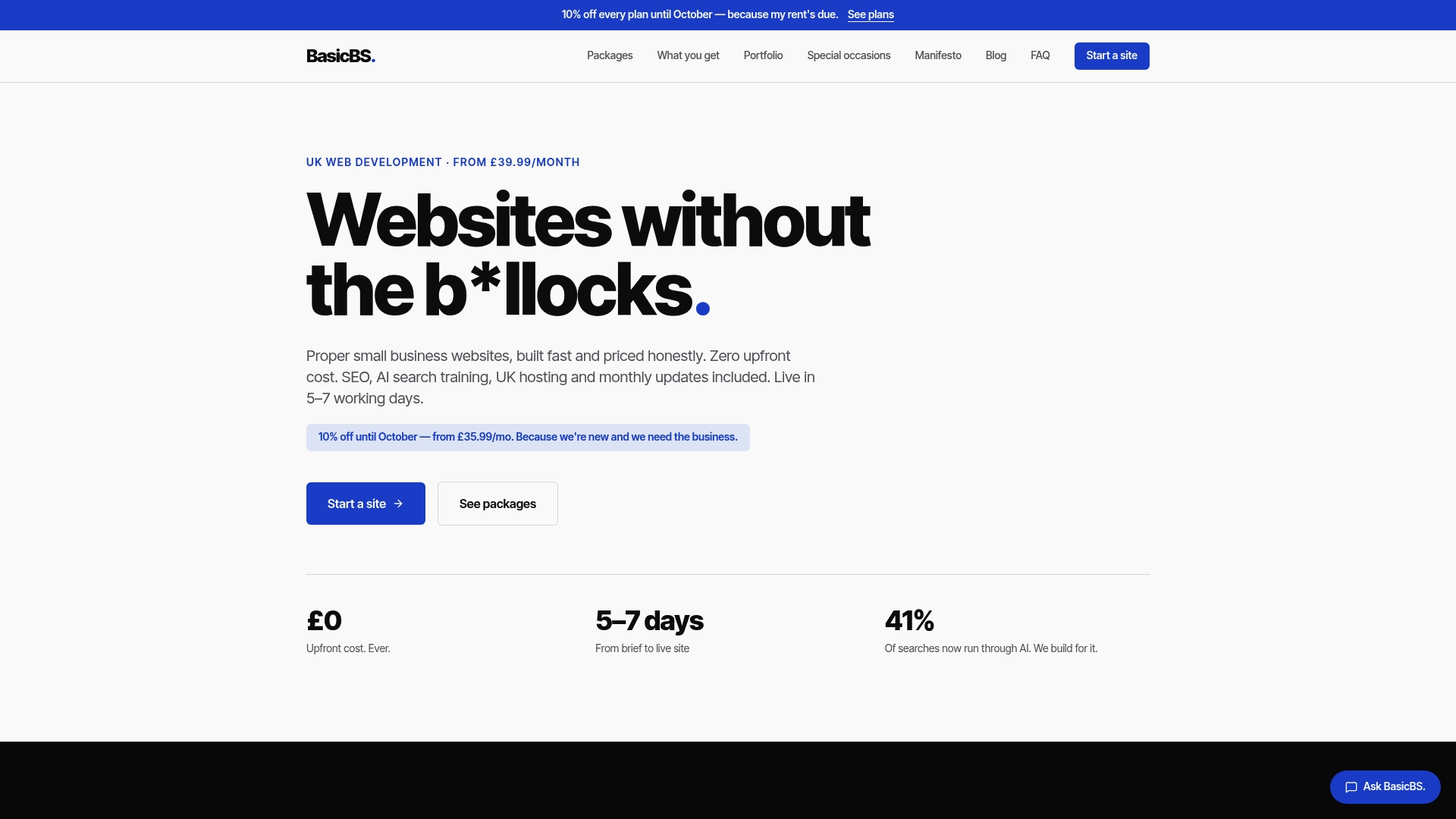
Every plan starts from £39.99 a month, with zero upfront cost and no lengthy setup dragging on for months. Sites go live in 5 to 7 working days, complete with managed UK hosting, SSL, and SEO baked in rather than sold separately. If you’ve been burned by a cheap website that looked fine but performed badly, it’s worth reading why cheap website builds tend to fail before you commit elsewhere. Browse real examples of finished sites to see the standard, then get in touch to check availability for your business and get a straightforward quote.
Sources
Check your markup against schema.org’s FAQPage and HowTo specifications before assuming it works. For deeper technical grounding on where SEO and generative search requirements overlap, this practical GEO playbook is worth a read. Run your own prompt audits regularly, don’t set and forget them.
FAQ
How do you actually do answer engine optimization?
Start by writing a 40 to 60 word direct answer under each major heading, add FAQPage or HowTo schema, confirm the content renders in plain HTML, and run a weekly prompt audit across two or three AI platforms to track what gets cited.
What’s the difference between AEO and SEO?
SEO optimises for ranking position on a search results page, while AEO optimises for being quoted or cited inside an AI-generated answer; the two overlap heavily on fundamentals like crawlability and topical authority but diverge on formatting and measurement.
What’s the best tool for answer engine optimization?
There’s no single definitive tool, but a combination of a structured data validator against schema.org’s specifications, a prompt-testing routine across major AI platforms, and a website built with AI training from the ground up, like the approach Basic-bs takes, covers most of what AEO requires.
What’s a good example of AEO in action?
A local business FAQ page stating its exact hours, pricing, and service area in a plain, self-contained sentence, marked up with FAQPage schema, is a strong example, because it gives an AI system an unambiguous fact to lift rather than a vague marketing paragraph to interpret.