Generative Engine Optimization: Passage First for Marketers and SEOs
Generative engine optimization (GEO) means structuring your content and entity signals so tools like ChatGPT, Perplexity and Google’s AI Overviews actually cite your pages when they answer a question. It builds on SEO rather than replacing it. If you do one thing this week, do this: rewrite your top passages so they answer the question in the first sentence, then bolt on one verifiable statistic with a proper citation.
TL;DR:
- Optimizing for citations and paraphrases inside AI answers requires rewriting passages to answer questions upfront with verifiable statistics and expert quotes.
- Passage-level content, such as self-contained paragraphs and structured data, is critical, as AI models extract and synthesize key information from these units.
- Ensuring technical SEO fundamentals like server-rendered HTML, fast load speeds, and correct schema are necessary for your content to be eligible for AI citation.
- Regularly updating high-value pages every few months with fresh statistics and new FAQs helps maintain and improve AI citation chances.
- Specificity and human-sourced facts, rather than volume or keyword stuffing, are the main differentiators for increasing AI-driven mentions and visibility.
Table of Contents
- What is generative engine optimization and how does it differ from SEO?
- Why does generative engine optimization matter now?
- What tactics actually increase AI citation probability?
- Is your page even crawlable and fast enough to be cited?
- How do you measure whether GEO is actually working?
- What’s the fastest way to optimise a page for GEO?
- What mistakes and regulatory risks should you avoid?
- How does BasicBS put GEO into practice for small businesses?
- Where has generative engine optimization actually worked?
- How often should you update content for GEO?
- Where is GEO heading next?
- A pragmatic take on the GEO hype
- Get your site GEO-ready without the agency price tag
- Sources
- FAQ
What is generative engine optimization and how does it differ from SEO?
Traditional SEO chases a position in a list of ten blue links. Generative engine optimization chases something different: a mention, a quote, or a paraphrase inside an AI-written answer. That’s a genuinely different game, because the “ranking” a large language model produces isn’t visible to you the way a SERP is. It’s happening inside a retrieval and synthesis process, pulling passages from multiple pages and stitching them into one response.
Generative engines work by retrieving candidate passages (not whole pages) from an index, then asking a model to synthesise an answer from those fragments. That means your unit of optimisation shifts from “the page” to “the paragraph.” A page can rank nowhere near the top of Google and still get lifted into an AI answer, provided the right forty words sit in the right place. Vendor studies on AI Overview citations found that a sizeable share of citations come from outside the classic top ten organic results, which tells you extraction and ranking are no longer the same contest.
Entity salience and information gain become the new currency. A generative engine wants to know: does this passage name a clear subject, state something specific, and add a fact the model hasn’t already seen five times elsewhere? The practical differences boil down to:
- Objective: SEO optimises for position; GEO optimises for citation and paraphrase probability.
- Unit: SEO thinks in pages; GEO thinks in self-contained passages.
- Content priority: SEO rewards comprehensiveness; GEO rewards distinctiveness and verifiable specifics.
- Signal: SEO leans on backlinks and rank signals; GEO leans heavily on entity clarity and structured data.
Google’s own guidance is blunt about the overlap: crawlable, indexable pages with solid site speed, clear content and demonstrable expertise remain the prerequisite for inclusion in AI-driven search features. GEO doesn’t skip SEO homework. It adds a second layer on top of it.
Why does generative engine optimization matter now?
Citation is decoupling from rank, and the evidence for it is now specific enough to act on. The Princeton GEO study, often called GEO-bench, tested which content tactics actually shift a page’s share of an AI-generated answer. The results are worth building a content calendar around.
Adding a quoted expert greatly lifted a page’s share of an AI answer. Adding statistics also increased visibility significantly. Simply citing sources provided a notable boost — GEO-bench, Aggarwal et al.
Combining tactics, particularly fluent writing paired with hard statistics, outperformed any single tactic on its own. That matters commercially because AI summaries are increasingly answering the question before the reader ever clicks through, which trims click-through rate for a lot of previously reliable queries. Tracking rank alone no longer tells you whether you’re winning. You need to know whether you’re being cited, not just whether you’re listed.
There’s a regulatory layer here too. The UK’s Competition and Markets Authority Fair Ranking CR is watching how AI features attribute and present publisher content, with an eye on transparency and fair treatment. For anyone publishing commercial content, that’s a signal to build your own audit trail of where and how you’re being cited, rather than assuming AI platforms will always credit you fairly.
What tactics actually increase AI citation probability?
Passage writing is the whole game, so start there. A generative engine favours a self-contained forty to sixty word block that names the subject and answers the question in its first sentence, with no throat-clearing before it. Write the verdict, then the evidence, not the other way round.
Here’s a practical sequence for rebuilding an existing page:
- Identify the question the passage should answer, and write it as the nearest H2 or H3.
- Answer in sentence one, naming the subject explicitly rather than using “it” or “this.”
- Add one verifiable statistic, dated where possible, with an inline citation to its actual source.
- Capture an expert quotation where one genuinely exists, formatted as a blockquote with clear attribution.
- Convert dense prose into a short list or table wherever you’re comparing options, steps, or figures.
- Check the passage stands alone if lifted out of context, because that’s exactly what happens when it’s cited.
Quotations, statistics and citations aren’t decoration. Aggarwal et al.'s findings above give you the actual size of each lever, so prioritise quotations and stats before you worry about tone or flourish. SEMrush’s practical GEO guide makes a similar case: answer-centric structure, with lists and schema doing the heavy lifting, consistently outperforms keyword-dense prose written for the old rules.
On markup, the schema stack that actually earns its place includes Article, FAQPage, and Organization, ideally joined with sameAs links pointing to verified profiles (Companies House, LinkedIn, trade bodies). This gives the model corroborating entity signals rather than a single unverified claim.
Pro Tip: Write your FAQ answers before you write the rest of the page. If you can’t answer the question in three plain sentences up front, the rest of the passage probably can’t either.
Is your page even crawlable and fast enough to be cited?
None of the passage-level work matters if the page underneath it can’t be read cleanly by a crawler in the first place. This is the unglamorous half of GEO, and it’s the half most marketers skip.
Check these before you touch a single sentence:
- Server-rendered HTML: if your key content only appears after JavaScript executes client-side, some crawlers will miss it entirely.
- No blocking robots directives: audit
robots.txtand meta robots tags for accidental “noindex” or “disallow” on pages you actually want cited. - Mobile-first speed: slow load times hurt both classic ranking and the likelihood a crawler bothers to fully render your page.
- Complete JSON-LD: implement the full stack (Article, FAQPage, Organization) rather than a single schema type in isolation.
- Visible text matches schema: never mark up a claim in structured data that doesn’t appear, in plain words, on the page itself.
- Consistent canonical tags and publish dates: engines weigh recency and authority, and conflicting dates confuse both.
Google’s own developer guidance is explicit that crawlable, indexable pages remain the baseline for any inclusion in generative features, AI-only or otherwise. There’s no special back door for AI visibility that skips the fundamentals. Server-rendered JSON-LD using the @graph pattern with proper sameAs linkage is specifically flagged as correlating with better AI visibility, so it’s worth getting right rather than bolting on as an afterthought.
How do you measure whether GEO is actually working?
Rank tracking alone will lie to you here, because a page can sit outside the top ten and still get cited repeatedly in AI answers. You need a different scoreboard.
Track these instead:
- Citation frequency: how often your domain or specific URL is named or quoted across a fixed set of test prompts run weekly.
- Share-of-answer / position-adjusted word count: what proportion of a generated answer’s total content traces back to your passage, not just whether you’re mentioned at all.
- Passage-level pulls: which specific paragraph or sentence got lifted, so you know what worked and can repeat it elsewhere.
- Query-set consistency: run the same prompt set on a fixed schedule (weekly or fortnightly) rather than checking ad hoc, so movement is comparable.
There’s no single dominant free tool for this yet, so most teams stitch together a manual prompt panel, Search Console’s query data as a proxy signal, and a lightweight scraping script or a third-party citation tracker where budget allows. Treat each content change as an experiment: change one passage, log the version and date, then re-run your prompt set two to four weeks later to see if citation frequency moved. Without that discipline you’re just guessing whether the quotation you added last month did anything at all.
What’s the fastest way to optimise a page for GEO?
Speed matters here because citation windows shift as generative engines refresh their indexes, so a page that’s dragging its feet loses ground it can’t easily win back. Work through pages in this order:
- Triage by value, not alphabetically. Start with pages that already carry traffic or convert well, since a citation lift there pays off fastest.
- Rewrite the opening passage into a BLUF answer, naming the subject in sentence one.
- Insert one dated statistic with an inline link to its real source, and one expert quotation formatted as a blockquote if you genuinely have one.
- Add three to five FAQ pairs answering the actual questions people ask about the topic, each answer under three sentences.
- Fix or add JSON-LD, checking Article and FAQPage markup matches the visible page text word for word.
- Confirm server rendering by viewing the page’s raw HTML source, not just the rendered browser view.
- Deploy, record the version and date, then leave it alone for two to four weeks while you monitor citation frequency.
- Iterate on the passages that got pulled, and drop the tactics that didn’t move the needle.
Pro Tip: Don’t rewrite ten pages at once. Fix one, log what changed, wait for the citation data, then apply what worked to the next batch. Otherwise you’ll never know which change actually mattered.
What mistakes and regulatory risks should you avoid?
Keyword stuffing, the old SEO crutch, actively hurts GEO. Generative engines are trained to favour natural, fluent language and clear entities, so cramming a phrase in five times reads as noise rather than relevance and can actually reduce extraction quality.
The other trap is mismatched markup: never mark up a claim in JSON-LD that doesn’t appear in plain text on the page. That gap looks like manipulation to a model trained to check consistency between structured data and visible content, and it’s the kind of thing that erodes trust signals over time rather than building them.
On the regulatory side, the CMA’s Fair Ranking CR puts transparency and non-discriminatory treatment of publishers at the centre of how AI search features should behave. It’s not a set of rules for you to follow directly, but it signals where scrutiny is heading, and it’s a good reason to keep your own record of what you publish, when, and how it gets attributed.
- Avoid repeating your target phrase mechanically across headings and passages.
- Never let schema claim something the visible page doesn’t actually say.
- Keep a simple log of publish dates and content versions for your own attribution evidence.
How does BasicBS put GEO into practice for small businesses?
This is exactly the sort of groundwork BasicBS builds in from day one, rather than bolting on later as an expensive add-on. Every site launched includes AI search training, SEO groundwork, managed hosting with SSL, and monthly updates, which covers the technical prerequisites above without you needing to hire a developer.
In practice, that means passage rewrites for BLUF structure, a full JSON-LD schema stack, and speed optimisation are handled as standard, not sold as premium extras. For a sole trader or trade business trying to work out how to get their business into ChatGPT search results without an in-house marketing team, that’s the practical route in.
Where has generative engine optimization actually worked?
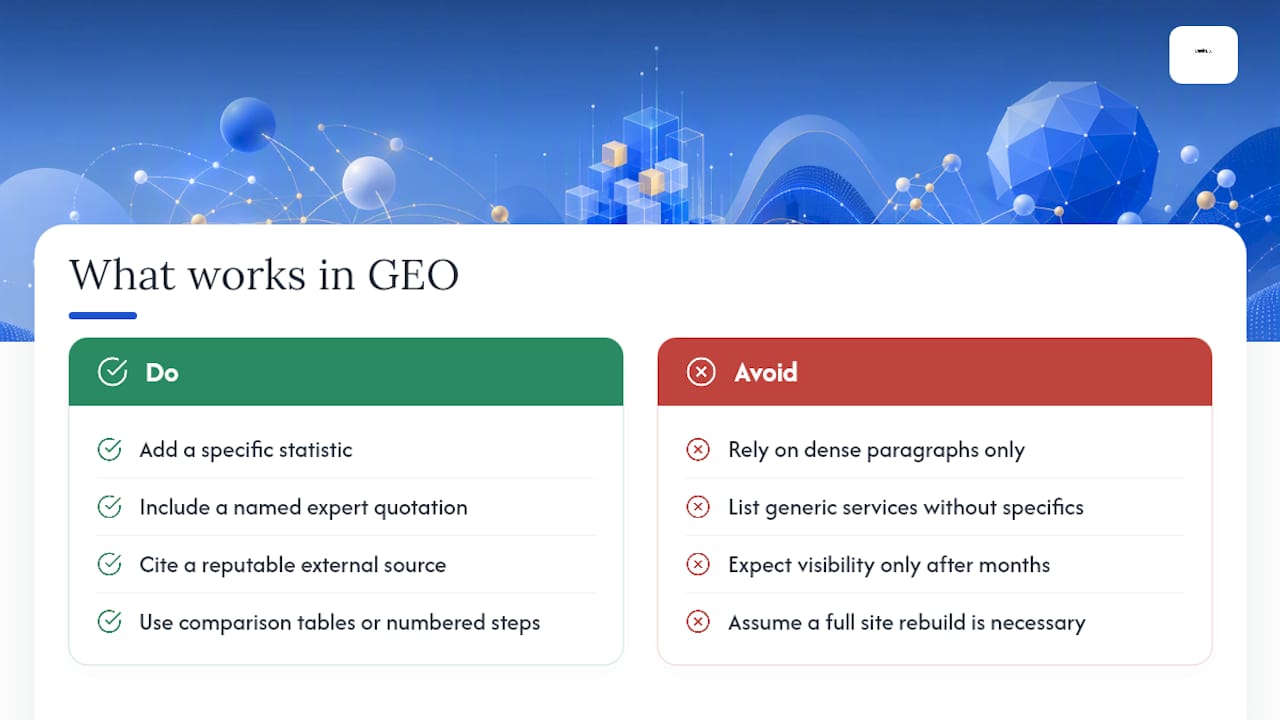
The clearest wins tend to follow the same pattern from GEO-bench: pages that added a specific statistic, a named expert quotation, or a properly cited external source saw a measurable lift in their share of AI-generated answers, even without a rewrite of the entire page. That’s the encouraging part. You don’t need to rebuild a site from scratch to see movement.
Trade and local service pages illustrate this well. A plumber’s page listing generic services rarely gets pulled into an AI answer about “how much does a boiler service cost.” A page that states the typical service window, names the qualification the engineer holds, and cites a real source for a safety statistic stands a much better chance, because it gives the model something concrete to lift.
The pattern holds for content type too. Comparison tables and short numbered steps get extracted more readily than dense paragraphs, because a generative engine can parse a table row as a discrete, self-contained fact far more easily than it can pull a clean answer out of a 200-word block of prose. Pages built around clear FAQPage schema, with each answer already written in the extractable style GEO rewards, tend to show up in answer summaries surprisingly quickly after publication, often within the next crawl and reindex cycle rather than months later.
The common thread across every case that’s worked isn’t scale or budget. It’s specificity: a real number, a real quote, a real source, written in a passage that could survive being lifted out of context entirely on its own.
How often should you update content for GEO?
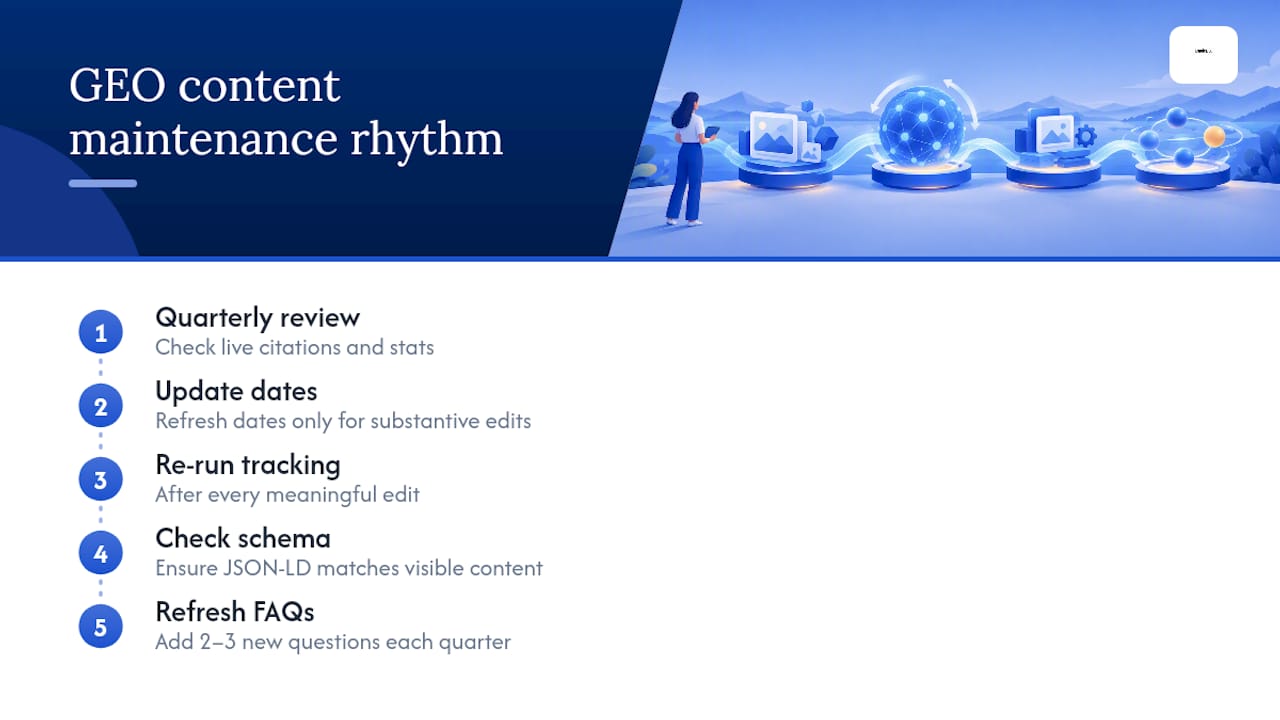
Content decays for GEO faster than most marketers expect, because generative engines re-crawl and re-synthesise on their own schedule, not yours. A statistic that was current last year can quietly become the wrong answer, and an unattributed claim that once slid through can start working against you as models get better at checking sources.
Set a simple maintenance rhythm instead of treating a GEO rewrite as a one-off project:
Review your highest-value pages every quarter, checking that every statistic still carries a live citation and hasn’t quietly drifted out of date. Refresh publish and “last updated” dates whenever you make a substantive change, not a cosmetic one, since inconsistent dates confuse the trust signals engines rely on. Re-run your citation tracking prompt set after every meaningful edit, so you can tell whether a change helped or did nothing.
Keep an eye on schema drift too. Pages get redesigned, content gets shuffled, and JSON-LD markup quietly falls out of sync with what’s actually visible on the page. That mismatch, even when accidental, is exactly the kind of inconsistency that erodes the trust a generative engine places in your content over time.
Treat FAQ sections as living content rather than a launch-day checkbox. New questions surface constantly in search behaviour, and adding two or three freshly answered questions each quarter keeps a page relevant to what people are actually asking now, not what they were asking when the page first went live.
Where is GEO heading next?
Expect the line between SEO and GEO to blur further rather than separate into two disciplines, because the underlying infrastructure, crawlable pages, clean schema, and fast servers serve both. The practical skill set marketers need is converging: write for humans first, structure for extraction always, and treat entity clarity as non-negotiable groundwork rather than a nice-to-have.
Passage-level tracking tools will mature quickly, moving from the manual prompt panels most teams run today towards more standardised citation dashboards, similar to how rank trackers matured a decade ago. Regulatory attention, following the CMA’s lead, will likely tighten further around attribution transparency, which means the businesses keeping their own citation records now will be better placed when platforms are forced to disclose more.
The advantage will keep shifting towards specificity over volume. As more publishers catch up on basic GEO tactics, quotations and statistics that are common knowledge stop moving the needle, and genuinely original data, named experts, and dated first-party facts become the differentiator. Generic AI-generated filler, ironically, is likely to become actively counterproductive as generative engines get better at recognising and discounting it in favour of verifiable, human-sourced specifics.
A pragmatic take on the GEO hype
Most of the GEO advice doing the rounds treats it as a mystical new discipline, when the evidence actually says something plainer: write clearer answers, back them with real facts, and make sure a machine can read your page in the first place. The GEO-bench numbers are the strongest thing anyone has published on this, and they point at unglamorous tactics, a quote here, a statistic there, not some secret algorithmic trick.
Where conventional advice falls short is in treating GEO as separate from technical SEO. It isn’t. A beautifully written passage sitting behind a slow, JavaScript-rendered page with broken schema will never get cited, no matter how good the writing is. The boring groundwork still comes first.
If you take one thing from this guide, prioritise your highest-traffic pages, rewrite their opening passages to answer first, and add one real statistic with a real citation. Do that consistently before you chase anything more elaborate. Automated content generation tools tempt marketers into producing volume instead of specificity, and generic AI output tends to work against citation rather than for it once engines get better at spotting filler.
— Rhys
Get your site GEO-ready without the agency price tag
BasicBS is the alternative to a traditional web agency for small businesses that need AI search readiness without a five-figure invoice or a locked-in contract. Every build starts from a one-off setup fee from £100, with the Website Sale! plan available for £10 per month, and includes AI search training, SEMrush-led SEO, managed UK hosting with SSL and monthly updates as standard, not as an upsell.
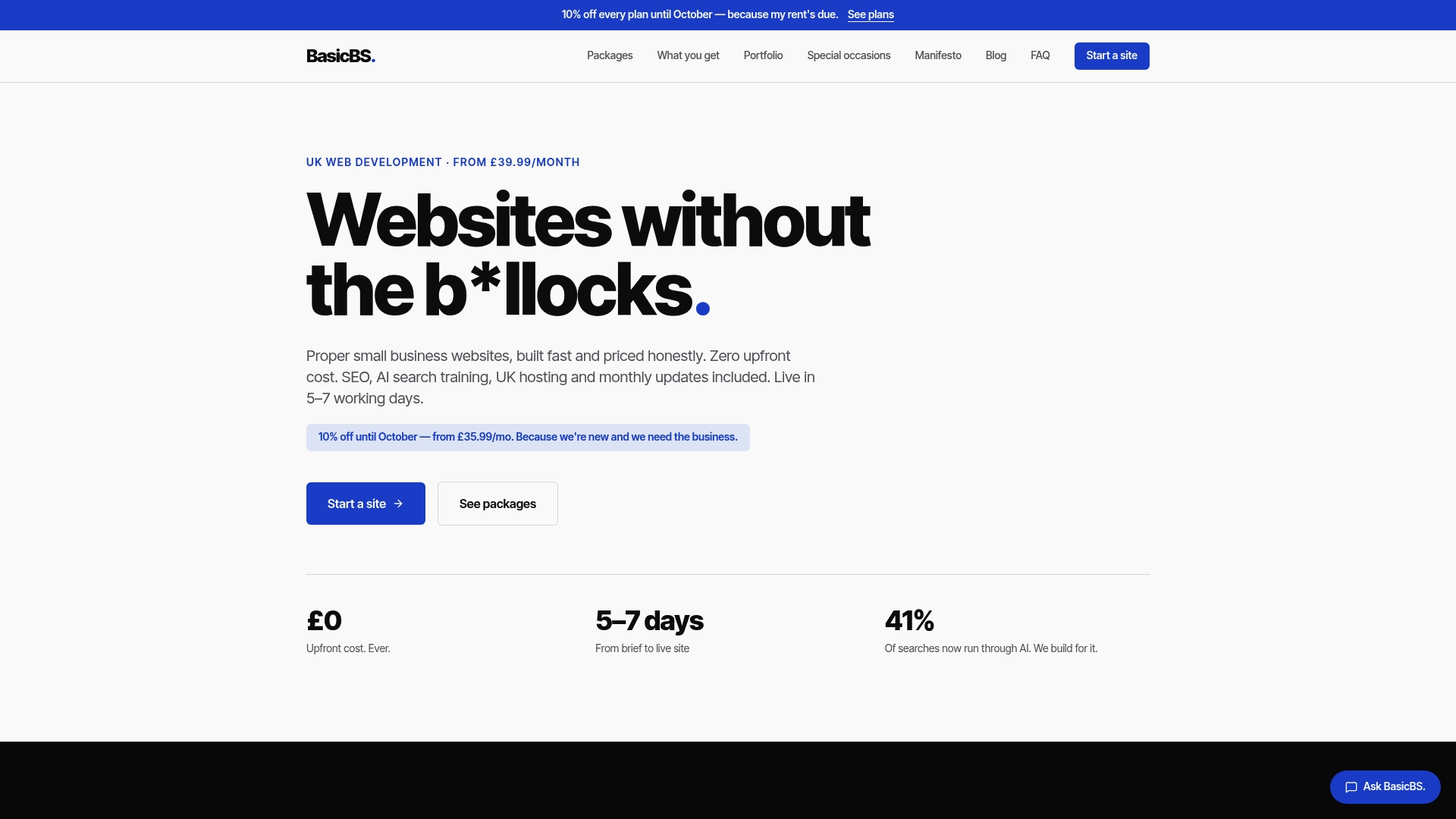
That matters because most of what this guide covers, server rendering, schema, passage structure, fast load times, is exactly what BasicBS builds into every site from the outset, whether you’re a plumber wanting a proper plumber website design package, an electrician after straightforward web design for electricians, or a sole trader who just wants a simple website without a monthly contract that outlives its usefulness.
If your current site is invisible to ChatGPT and Google’s AI Overviews, or you’re simply tired of vague agency pricing, see how BasicBS builds sites that don’t disappear from AI search and get a straightforward quote.
Sources
- Optimizing your website for generative AI features on Google Search
- Fair Ranking CR: final decision — Competition and Markets Authority
FAQ
Is generative engine optimization a real, established practice?
Yes. GEO is grounded in published research, including the Princeton GEO-bench study, and it’s now referenced in official guidance from Google and practical guides from SEO platforms like SEMrush. It’s a genuinely distinct discipline sitting alongside SEO, not a marketing buzzword with no substance behind it.
How do I learn SEO as a beginner before tackling GEO?
Start with the fundamentals: crawlability, site speed, clear content structure and basic keyword research, since Google confirms these remain the prerequisite for any AI-driven visibility too. Once those are solid, layer GEO tactics like BLUF passages, statistics and schema on top, rather than trying to learn both at once.
Is GEO replacing SEO entirely?
No. GEO extends SEO rather than replacing it, because crawlable, well-structured, fast pages are still the baseline both disciplines need. Think of GEO as a second layer of passage-level tactics sitting on top of solid SEO foundations, not a separate system that makes SEO redundant.
Is SEO going away now that AI answers questions directly?
SEO is changing, not disappearing. Clicks from some queries are shrinking as AI summaries answer questions directly, but ranking, crawlability and site quality still determine whether your content gets retrieved and cited in the first place. Businesses that ignore SEO fundamentals in favour of chasing AI citation alone tend to lose ground on both fronts.
What does BasicBS charge for a GEO-ready website?
The plan runs from a monthly fee, with builds starting from a one-off setup fee and no upfront cost required before work begins. Every site includes AI search training and SEO groundwork this guide recommends, so GEO readiness comes built in rather than as a separate line item.