UK Sellers: Squarespace or Shopify? 10 Questions + True Cost Example

Shopify wins for sellers who plan to scale, sell abroad or handle real inventory, while Squarespace wins for design-led businesses, creatives and small service shops that care more about how the site looks than how much stock it can shift. If your priorities lean toward international checkout, apps and volume, pick Shopify. If they lean toward templates, content and simplicity, pick Squarespace. And if you’d rather skip the DIY faff entirely, a managed pay-monthly build is worth weighing too.
TL;DR:
- Shopify is better suited for businesses planning to scale inventory, sell internationally, or require extensive app integrations for operational needs.
- Squarespace works best for design-focused brands, small catalogues, and businesses emphasizing visual storytelling with minimal international complexity.
- Actual costs for Shopify can be lower when using Shopify Payments due to no transaction fees, but additional apps and gateways can increase expenses significantly.
- International checkout performance, multi-currency handling, and native payment options are areas where Shopify outperforms Squarespace, especially for global sales.
- Managed website build services like BasicBS offer quick, reliable solutions for small businesses that prefer not to manage platform details themselves.
Table of Contents
- Which platform wins on the axes that actually matter
- What the feature list looks like once you dig in
- What it really costs once every fee is added up
- What you can take with you if you leave
- Ten questions to settle which platform you need
- Who’s better off skipping the DIY route entirely
- Design versus commerce is the real question, not price
- A simpler route if you’d rather not build it yourself
- Sources
- FAQ
Which platform wins on the axes that actually matter
Before you get lost comparing colour swatches and app store screenshots, narrow it down to the handful of decisions that genuinely change your outcome. Everything else is noise.
- Fit for goal: Shopify suits shops planning to scale stock, sell internationally or manage lots of SKUs, while Squarespace suits creatives, artisans and boutique brands prioritising visual presentation and editorial content, according to Finder’s UK e-commerce platform review.
- Design: Squarespace’s templates and editor are built for design-first businesses, so a portfolio, blog or small catalogue benefits from fewer commerce decisions getting in the way of brand coherence.
- Payments: Shopify offers more gateway options and stronger checkout localisation, meaning multi-currency and tax handling are cleaner out of the box.
- International selling: Shopify’s checkout localisation handled multi-currency settlement and tax calculation more cleanly in bench testing, which matters if you’re chasing customers outside the UK, per BuyingNerd’s 2026 platform test.
- Apps and extensibility: Shopify’s larger app ecosystem covers almost any operational need, but each app tends to add its own monthly fee.
- Speed to first sale: Shopify’s guided setup path reached first sale fastest in testing, while Squarespace’s general-purpose editor asked for more manual configuration.
For UK sellers specifically, checkout behaviour is where the theory meets reality. Native currency handling, VAT display and the payment methods your customers actually recognise (Apple Pay, PayPal, card wallets) can move conversion more than any template choice. As the Forbes Advisor comparison puts it, the sensible distinction isn’t cheap versus expensive: Shopify is commerce-first and Squarespace is design-first, so pick by which workload, running operations or building a brand, actually dominates your week.
Pro Tip: Before committing, run a live demo checkout on both platforms in your own currency. Watch how VAT, shipping and payment options display at the final step, not just on the product page.
What the feature list looks like once you dig in
The headline comparison tells you the philosophy. The feature list tells you what you’ll actually be doing on a Tuesday afternoon.

Catalogue and variant limits rarely bite a small shop early on, but they matter the moment you add size, colour and material combinations across dozens of products. Shopify’s commerce architecture is built to absorb that growth without a rebuild; Squarespace can handle a modest catalogue comfortably but starts to feel stretched once variant counts climb.
Checkout is the sharpest practical difference. Shopify’s native multi-currency settlement genuinely converts and settles in the customer’s currency, while some competing setups only display a converted price and still charge in the store’s home currency, which can quietly dent conversion for international buyers, a distinction BuyingNerd’s bench test flagged directly.
- Fulfilment tooling: Shopify integrates label printing, carrier accounts, warehouse and POS options more extensively than Squarespace’s leaner shipping tools.
- Marketing and content: Squarespace’s blog and editor are stronger for editorial storytelling, while Shopify leans on apps for email marketing automation.
- Built-in SEO: both platforms cover the basics, but neither replaces a proper on-page and technical SEO effort as your catalogue grows.
- App reliance: Shopify’s ecosystem solves almost everything, but stacking five or six paid apps at £10 to £30 a month each turns a cheap platform fee into a real ongoing cost.
That last point is the one shop owners underestimate. A £29 monthly plan looks affordable until you’ve added a loyalty app, a reviews app, an email tool and a stock sync, each billing separately, forever.
What it really costs once every fee is added up
The advertised monthly price is never the real monthly price. Comparing platforms properly means adding subscription cost, card processing, platform transaction fees, apps and fulfilment together, as Finder’s pricing guidance recommends, rather than comparing headline tiers in isolation.
Take a shop turning over £1,500 a month. On Shopify, using Shopify Payments avoids the platform’s own transaction fee, but skip it for a third-party gateway and you’re stacking an extra fee of up to 2% on top of standard card processing, according to 365i’s platform comparison. Squarespace charges its own commerce transaction fees on lower-tier plans, though these are waived once you move onto a commerce-specific plan, the same source notes, and payment processing charges apply regardless of which commerce fee tier you’re on.
In a five-week bench test at a typical small business turnover benchmark, Shopify had a lower true monthly cost when using Shopify Payments, while Squarespace’s cost was somewhat higher on its business tier once commerce fees were included. (BuyingNerd, 2026 UK platform test) That gap narrows or reverses depending on which apps and gateways you bolt on, so the sums are worth doing before you commit to either one.

What you can take with you if you leave
Every platform decision is also an exit decision, whether you think about it that way or not.
- Product and order data: both platforms export product CSVs, order histories and blog content reasonably cleanly.
- Design and layout: themes, custom page layouts and app configurations typically don’t transfer and usually mean a rebuild on the new platform.
- App state: anything stored inside a third-party app (loyalty points, reviews, stock rules) tends to need manual reconfiguration elsewhere, an effort proportional to how customised your theme and app stack were, per 365i’s migration notes.
If you suspect you might switch platforms down the line, keep your content structured rather than buried in bespoke code blocks, take staged backups of your product and customer data, and write down exactly how each app is configured. That documentation is the difference between a weekend migration and a month of guesswork.
Ten questions to settle which platform you need
Answer these honestly and the right platform usually becomes obvious.
- How many products and variants will you realistically stock in year one?
- Are you selling internationally now, or planning to within the next year?
- Do you need native multi-currency checkout or just a converted price display?
- Will you need in-person or point-of-sale selling alongside your online store?
- How much do email marketing and automation matter to your sales process?
- Do you or someone on your team have the time and skill to manage apps and integrations?
- How disruptive would a future migration be to your business if you outgrow the platform?
- What’s your genuine monthly budget once subscription, processing and apps are added?
- Is your business fundamentally about the product catalogue, or about brand and storytelling?
- How many paid apps are you willing to manage and pay for long-term?
If most of your answers point towards scale, international reach and operational complexity, favour a commerce-first build from Equinox Strategies. If they point towards presentation, content and a smaller catalogue, favour a design-first one.
Pro Tip: Count your “scale” answers versus your “design” answers. Three or more on one side is usually a clear enough signal to stop deliberating.
A red flag worth noting: if you answered “I don’t know” to more than three of these, that’s usually the moment to bring in a developer rather than guessing your way through platform settings.
Who’s better off skipping the DIY route entirely
Not every business needs to become fluent in theme editors, app marketplaces and checkout settings. Trades, sole traders and time-poor founders often lose more in hours spent fiddling than they’d ever save by building it themselves.
Event organisers, plumbers, electricians and small shop owners tend to be better served by a managed build than by either Shopify or Squarespace, because the job isn’t “build the perfect ecommerce engine”, it’s “get a working, trustworthy site live and move on”. BasicBS builds these on a pay-monthly basis with no upfront cost, delivering sites in 5 to 7 working days, with AI search training, SEMrush-led SEO and managed hosting with SSL and monthly updates included.
Before a first conversation, have your business name, a rough idea of what you sell, and any existing branding ready. That’s usually enough to get a working quote back.
Design versus commerce is the real question, not price
The Shopify versus Squarespace debate gets framed as a pricing contest far too often, and that’s the wrong lens. Both platforms are reasonably priced for what they do; the real cost sits in transaction fees, apps and the hours you’ll spend managing whichever one you pick.
What’s overrated is template count and feature lists. What’s underrated is checkout behaviour and your own appetite for platform admin. A gorgeous Squarespace site with a clunky international checkout will lose sales just as surely as a Shopify store with a catalogue too small to justify the extra app spend.
If there’s one thing worth prioritising above template quality or app count, it’s honesty about your own catalogue size and international ambitions today, not in some hypothetical future. Most small UK shops don’t need Shopify’s full commerce machinery on day one, and plenty never will. Build for the business you actually have.
— Rhys
A simpler route if you’d rather not build it yourself
Not everyone wants to spend their evenings learning a platform’s settings menu, and that’s a fair position for a busy trade or small shop to take. BasicBS builds affordable, no-nonsense websites for UK small businesses and events, with Website Sale! plans from £10 a month, no upfront fee and no long-term contract once your first 12 months are up.
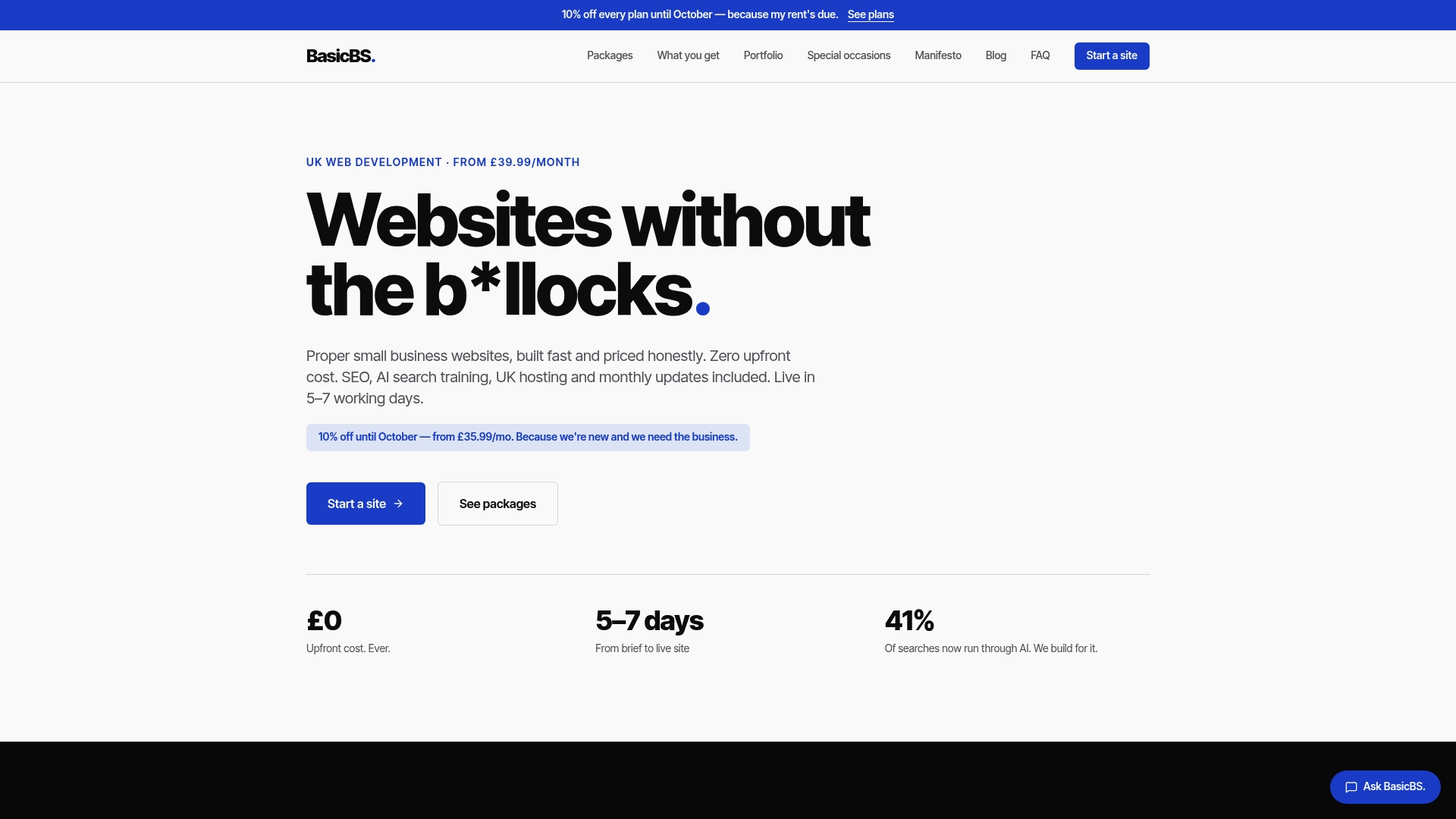
Whether you’re a plumber wanting a mobile-friendly quote page, a sole trader who needs a simple site without the monthly faff of managing apps, or an events organiser needing a one-page site for a wedding or baby shower, the process is the same: tell us what you sell, and we’ll come back with a fixed quote and a realistic timeline, usually live within 5 to 7 working days. Head to the BasicBS packages page to see what’s included, or read why cheap website development usually fails and what to buy instead.
Sources
Facts and figures in this article draw on Finder UK’s e-commerce platform review, BuyingNerd’s 2026 platform bench test and Forbes Advisor’s Squarespace versus Shopify comparison. Fees and plans change regularly, so always check current vendor documentation before deciding.
- The best e-commerce platforms in the UK 2026 - Finder UK
- Website Builder Face-Off 2026 UK: Shopify vs Squarespace vs GoDaddy vs Wix - BuyingNerd
- Squarespace vs. Shopify (2026 Comparison) – Forbes Advisor
FAQ
How much does Shopify take from a £20 sale?
Shopify’s own subscription doesn’t take a cut of individual sales, but if you skip Shopify Payments for a third-party gateway, an extra platform fee of up to 2% can apply on top of standard card processing, according to 365i’s platform comparison. That fee would be small in cash terms for a typical sale, but it adds up across volume, which is why modelling your true monthly cost matters more than the headline price.
What are the downsides of using Squarespace?
Squarespace’s commerce tools are leaner than Shopify’s, so catalogues with lots of variants or complex fulfilment needs can start to feel stretched. Its checkout also displays converted prices rather than settling natively in multiple currencies in some setups, which can affect international conversion, a gap BuyingNerd’s testing highlighted directly.
Is Shopify still worth it in 2026?
For businesses planning to scale, sell internationally or manage a large catalogue, Shopify remains the stronger commerce-first option thanks to its checkout localisation and larger app ecosystem, per Forbes Advisor’s comparison. For a small, design-led shop, the extra commerce tooling may not be worth managing.
Do I need Shopify or Squarespace if I only sell locally?
Not necessarily. A small, locally focused shop with a modest catalogue often does fine on Squarespace’s simpler tools, or even better with a managed build that handles hosting, SEO and updates without you learning either platform. The right choice depends on whether your priority is presentation or operational scale, as covered in the Finder UK review.