AI Ready in Weeks: Structured Data for AI Decision Makers

Structured data grounds AI: it feeds machines clean, labelled facts instead of guesswork, which cuts hallucinations and speeds up accurate answers. The practical routes are retrieval-augmented generation, knowledge graphs and lightweight JSON-LD markup, and none of them need a research team to get started. Before you buy anything, get one thing straight: how ready is your existing data?
TL;DR:
- Structured data improves AI accuracy by anchoring answers in verified facts, reducing hallucinations, and supporting auditability in regulated industries.
- The most effective implementation patterns are retrieval-augmented generation pipelines, knowledge graphs with symbolic queries, and hybrid search methods, each suited for different use cases.
- Ensuring data quality, metadata clarity, access control, and operational controls are crucial steps before deploying AI pilots to avoid unreliable or broken outputs.
- Start with industry-standard formats like JSON-LD, relational databases, and vector stores, and serialise data into JSON or HTML to help AI understand it better.
- Small businesses can establish AI-ready structured data within weeks by focusing on entity modelling, proper markup, and basic retrieval endpoints, without needing a full enterprise team.
Table of Contents
- What is structured data for AI?
- Structured vs unstructured data: when should you use each?
- How does structured data improve AI accuracy?
- What are the best implementation patterns for structured AI data?
- What does a data readiness checklist look like?
- Which formats and tools should you adopt first?
- How does this translate to a small-business pilot?
- A decision-maker’s perspective on getting this right
- Want a faster route to AI-ready structured data?
- Sources
- FAQ
What is structured data for AI?
Structured data is information stored so a machine can read it without guessing at meaning: a schema, typed fields, and relationships that connect one record to another. It’s the difference between telling a computer “the invoice is due soon” and giving it a field called due_date with a value it can actually calculate against.
You’ll already recognise the everyday shapes this takes:
- Relational tables and CSV exports, where every row follows the same columns
- JSON objects, where fields like
"price": 39.99carry both a label and a value - Knowledge graph triples, which link entities together (say, “Basic-bs” → “offers” → “website builds”)
- Semi-structured formats like XML and JSON that mix flexible layout with tagged fields
Unstructured data, by contrast, is a customer email or a scanned PDF with no fixed shape. AI can still read it, but it has to work far harder to find meaning inside it.
Structured vs unstructured data: when should you use each?
Task alignment decides which type of data actually helps. Feed the wrong sort into the wrong job and you get slow answers, wrong answers, or both.
- Use structured data for analytics, forecasting, text-to-SQL queries and grounding retrieval-augmented generation, where precision and repeatability matter more than nuance.
- Use unstructured data for training large language models on language patterns, or when you need free-text understanding, like summarising a stack of customer reviews.
- Combine both in hybrid pipelines: structured records supply the facts, unstructured text supplies the context and tone, and the AI system blends them at query time.
Most real-world AI projects need a bit of each. The trick is knowing which job you’re solving before you decide what to feed the model.
How does structured data improve AI accuracy?
Grounding is the whole game. Feeding a large language model well-organised, linked data measurably improves how accurately it answers, in both standard lookup tasks and more complex agent-driven workflows, according to research on structured linked data in retrieval-augmented generation. Separate work on the Struct-X framework shows that converting structured records into graph embeddings and trimming irrelevant tokens sharpens an AI’s reasoning on knowledge-graph questions and long documents, per ArXiv’s Struct-X paper.
Structured data improves AI outputs when:
- It reduces hallucination by anchoring answers in verified fields rather than plausible-sounding invention
- It speeds up training and feature extraction because the model isn’t parsing free text to find a number
- It supports auditability, which matters enormously in finance, healthcare, or anywhere a regulator might ask “how did the AI reach that answer?”
Pro Tip: Don’t let schema maintenance become an afterthought. A knowledge base that drifts out of date is worse than no structured data at all, because the AI trusts it anyway.
The honest limitation: structured data still has to fit inside a model’s context window, and every additional field you tag eats into that budget. There’s also real ongoing labour in keeping schemas current as your business changes.
What are the best implementation patterns for structured AI data?
Four architecture patterns cover most real deployments, and each carries its own trade-offs on latency, cost, and how much governance oversight it needs.
- Structured RAG pipeline. Query your database with SQL, chunk the results, generate embeddings, store them in a vector store, then let the LLM answer from that grounded context. Meilisearch’s guide to RAG for structured data documents how this sequence cuts hallucinations while still supporting real-time and business-intelligence style queries.
- Knowledge graph plus symbolic query. Best when questions require multi-hop reasoning, “which supplier delivered the part that failed in the batch sold to client X”, something a flat table struggles with.
- Text-to-SQL. Lets non-technical staff ask plain-English questions that get translated into database queries. Powerful for BI dashboards, but treat it carefully: a poorly sandboxed text-to-SQL layer can expose more of your database than intended, so query permissions need locking down before launch.
- Hybrid search. Combines exact filters (price under £50, in stock) with semantic vector matching (find me something similar to this). AWS outlines several of these managed patterns, including Amazon Q Business and Bedrock knowledge bases, each suited to different mixes of conversational, visual, or API-driven use, according to its breakdown of generative AI retrieval approaches.
| Pattern | Best for | Main trade-off |
|---|---|---|
| Structured RAG | Grounded Q&A, customer support | Needs a maintained vector store |
| Knowledge graph + symbolic query | Multi-hop reasoning | Higher setup complexity |
| Text-to-SQL | BI dashboards, ad hoc reporting | Security and query permissions |
| Hybrid search | E-commerce, catalogue search | Balancing real-time vs indexed data |
What does a data readiness checklist look like?
Before you approve a pilot, ask your team to walk through this. Salesforce’s guidance on AI data readiness is blunt about the consequence of skipping it: unreliable structured data (duplicate records, disconnected fields) leads directly to wrong answers from AI agents, according to Salesforce Trailhead’s assessment of structured data readiness.
- Data quality: measure completeness, deduplication rate, and freshness before you trust any dataset near an AI system
- Metadata: every field needs a clear label and a defined type; ambiguous columns confuse both humans and machines
- Access control: strip or mask sensitive fields before an AI agent gets anywhere near them
- Entity resolution: link records to authoritative IDs using
sameAsrelationships, so “Acme Ltd” and “Acme Limited” resolve to one entity - Operational controls: set an ingestion cadence, version your datasets, and build a rollback plan before go-live
Pro Tip: Start with entity modelling and sameAs linking to trusted IDs first. It’s the cheapest, highest-impact step you can take before touching a single line of pipeline code.
Teams that skip the operational controls, versioning, monitoring, a way to roll back, are usually the ones whose pilot works fine in testing and then quietly breaks in production three months later.
Which formats and tools should you adopt first?
Start with the formats that already have industry consensus behind them, rather than inventing your own.
- Schema.org and JSON-LD for marking up entities on your website. Google explicitly recommends this combination to help Search understand page meaning and to enable rich results, according to its guide to structured data basics. This also happens to be the foundation for schema for AI search visibility.
- Relational databases like PostgreSQL or MySQL for your core transactional records.
- Graph databases such as Neo4j when relationships between entities matter more than the entities themselves.
- Vector stores like Weaviate, Pinecone, or Chroma for semantic search and RAG retrieval, plus indexing engines like Meilisearch for fast, filterable lookups.
One format tip worth remembering: when you’re actually sending data to a language model, skip the raw CSV dump. Microsoft’s research team found that serialising structured data into HTML-like or JSON formats helps large language models understand it far better than plain delimited text, according to its study on LLM understanding of structured data.
How does this translate to a small-business pilot?
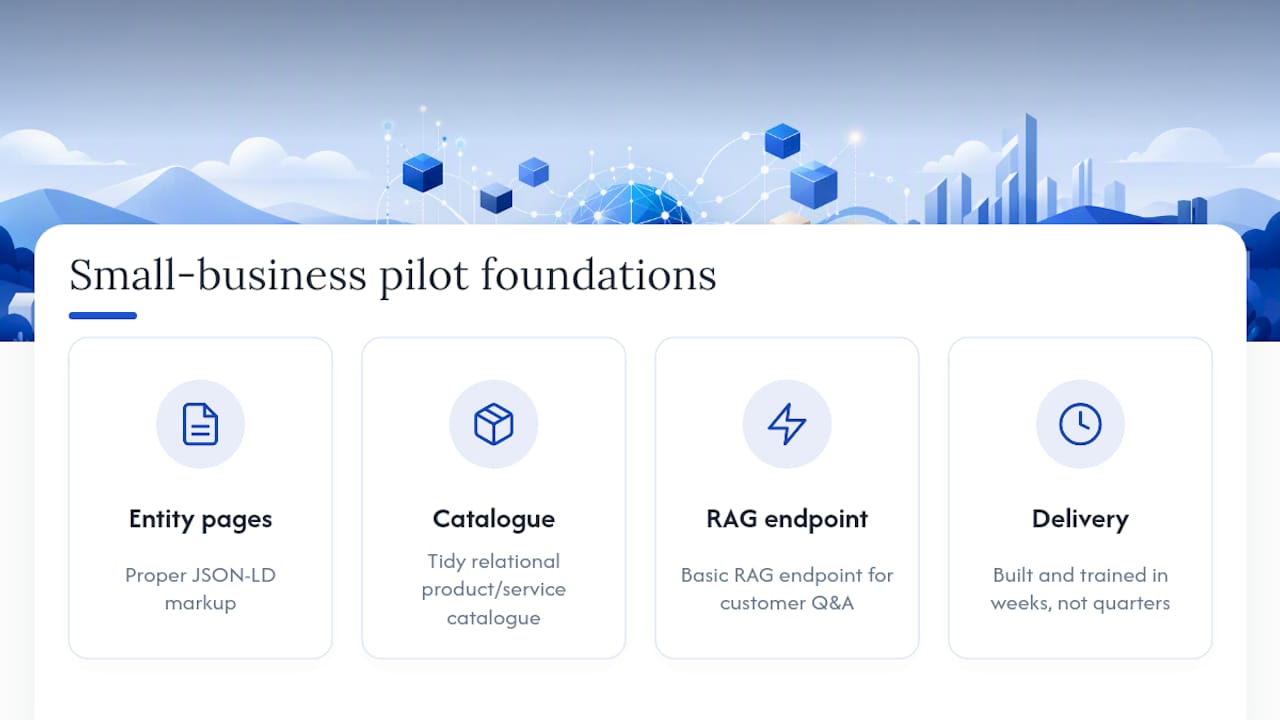
You don’t need an enterprise data team to get the basics right. A small business can realistically stand up entity pages with proper JSON-LD markup, a tidy product or service catalogue in a relational database, and a basic RAG endpoint answering customer questions, all within weeks, not quarters. Websites can be built with quick turnaround times and AI training included so sites are structured for how AI search engines actually read it. That’s the entity modelling and JSON-LD groundwork most guides treat as a six-month project, delivered as standard.
A decision-maker’s perspective on getting this right
The industry oversells the theory and undersells the plumbing. Nobody needs a lecture on transformer architecture to get value from structured data. They need someone to sit down, model their entities properly, and link them to something authoritative. Start there, run one small RAG pilot, and put a named person in charge of governance before you scale. Everything else is detail.
— Conor
Want a faster route to AI-ready structured data?
If your team is weighing up building this in-house against bringing in outside help, the honest answer depends on how much engineering time you have spare, and most small businesses don’t have much. Some providers offer monthly plans and quick live site delivery with AI training included so your entity data and JSON-LD markup are handled from day one rather than bolted on later.
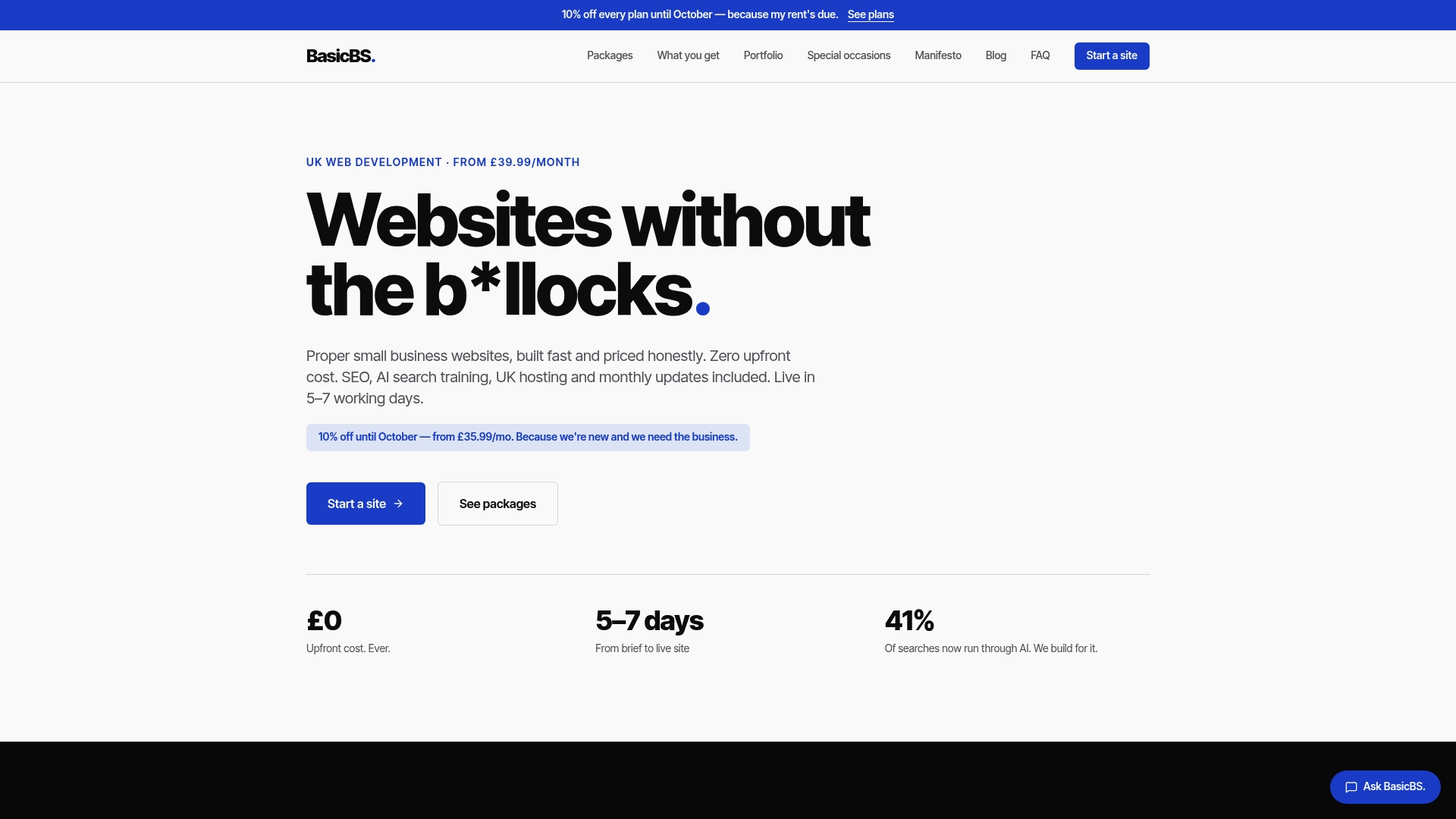
That matters because poorly structured websites carry real risk once AI search tools start relying on your data to answer questions about your business. If you’d rather see the approach before committing, browse examples of completed website builds, or go straight to the services page covering website builds, AI training, SEO and UK hosting to see what a managed pilot actually includes. For businesses further along, pairing your site with something like an AI answering service shows how grounded structured data extends into customer-facing tools too. Book a call and get a quote this week.
Sources
- ArXiv — structured linked data in RAG (2603.10700)
- Meilisearch — RAG for structured data
- Salesforce Trailhead — Assessing structured data readiness for AI
FAQ
What is structured data for AI?
It’s information organised into a defined schema, typed fields and clear relationships, letting AI systems retrieve and reason over facts accurately instead of inferring meaning from free text.
Which data structure is used in AI?
Relational tables, JSON objects, and knowledge graph triples are the most common structures, often combined with vector embeddings for semantic search in retrieval-augmented generation systems.
Does AI work better with structured data?
Yes for grounded, fact-based tasks: structured linked data in RAG systems improves answer accuracy, though free-text understanding still relies on unstructured training data.
How do I structure content for AI?
Mark up entities with schema.org vocabulary and JSON-LD, keep your database fields typed and labelled, and serialise anything sent to an AI model in JSON or HTML-like formats rather than raw CSV.
Should I build structured data in-house or use a managed service?
It depends on available engineering time. A managed build, like the entity pages and JSON-LD markup Basic-bs includes as standard, gets a small business AI-ready in days rather than months.