Launch Faster: Website Build Timeline for UK SMEs (4–10 weeks)

Most small-business websites go live in 4 to 10 weeks, and where you land in that range comes down to three things: how complex the site is, how ready your content is on day one, and how fast you sign things off. A simple brochure site with photos and copy already sorted can launch quickly. A custom SME site or online shop, with more integrations and more people weighing in on decisions, will generally take longer. The rest of this guide breaks that down phase by phase. Here’s a checklist to help you shave weeks off your own build.
TL;DR:
- Smaller websites with minimal integrations can typically launch in 4 to 8 weeks if content is ready and decisions are streamlined.
- Content delays, scope creep, and multiple decision-makers significantly extend project timelines, especially if admin tasks like accessibility or cookie compliance are left to the last minute.
- Preparing all content, policy pages, and decision protocols before starting can prevent weeks of avoidable delays during development.
- Complex sites with multiple integrations or e-commerce features usually fall into the 6 to 10-week range, depending on scope and readiness.
- Adhering to government accessibility and cookie regulations early reduces last-minute fixes that can push launch dates further back.
Table of Contents
- What are the phases of a website build timeline?
- How long does each type of website project take?
- What factors speed up or slow down a website build?
- How can you speed up your website build timeline?
- What accessibility and cookie rules apply to UK websites?
- What happens after your website goes live?
- What actually determines whether a website launches on time?
- Want a website that doesn’t take three months and a small fortune?
- Where can you check the official rules for accessibility and cookies?
- Sources
- FAQ
What are the phases of a website build timeline?
Every website project, no matter how basic or bespoke, moves through the same five phases. What changes is how long each one takes, and that’s mostly down to how prepared you are before the work starts.
Discovery and strategy (typically 1 to 2 weeks). This is where goals get nailed down, a sitemap gets drawn up, and someone decides what “success” actually looks like, whether that’s more enquiries, more bookings, or fewer people ringing to ask for opening hours. For a small trades business, this phase is often quick because the goal is simple: get found, get contacted, get the job. For a multi-location retailer, it takes longer because there’s more to map out.
Design and prototyping (typically 2 to 4 weeks). Wireframes get built, mobile layouts get checked (because most of your visitors will be on a phone), and accessibility gets baked in here, not bolted on later. Retrofitting accessibility after a design is locked is one of the most expensive mistakes a small business can make, which is why Gov recommends integrating it from the start rather than checking for problems at the end.
Development and build (typically 2 to 6 weeks). This is where the site actually gets built, whether that’s a templated build on a platform like WordPress or a fully custom job. Forms, payment gateways, booking widgets, and analytics tracking all get wired in during this stage. The wider the scope, the longer this phase runs; a five-page brochure site and a twelve-integration e-commerce build are not the same job, even if they look similar on a sitemap.
Content and SEO (often running alongside development). Copy, images, metadata, and structured data get loaded in, with careful attention to practical SEO management like the strategies described in Programs, Courses, and Clarity. This is the phase most likely to blow your schedule, because it depends entirely on you supplying finished material. A business with ready-to-go photos and service descriptions can run this in parallel with development. A business still waiting on a photographer or trying to write “About Us” copy from scratch will feel this phase drag.
Testing, QA, and launch (typically 1 week). Cross-browser and cross-device checks, an accessibility pass, cookie consent verification, and a final launch checklist. Rush this stage and you’ll spend far longer fixing things after go-live than you would have spent testing properly beforehand.
A representative well-run project of around 10 weeks typically breaks down as: discovery in weeks 1 to 2, design running weeks 2 to 5, development weeks 5 to 8, content wrapping in week 8, and testing through to launch in weeks 9 and 10. Industry estimates broadly agree that a small business site often launches in 4 to 8 weeks, with more complex builds taking longer.

How long does each type of website project take?
Not every website is the same job wearing a different logo. A one-page landing site and a full e-commerce store sit at opposite ends of the same timeline, and knowing which band your project falls into saves a lot of guesswork.
These bands come from UK-focused industry benchmarks for small business web design, and they hold up well against what most small firms actually experience. What pushes a project from one band to the next usually isn’t the number of pages, it’s the number of moving parts. A brochure site with a booking calendar, a payment gateway, and a customer login stops being a brochure site. Each integration adds testing time, and each third-party tool adds a dependency you don’t fully control. If your “simple” site idea includes a shop, a quote calculator, and a members’ area, budget for the SME or e-commerce band, not the brochure one.
What factors speed up or slow down a website build?
Some delays are baked into a project from day one. Others sneak in halfway through and quietly add weeks. Knowing which is which lets you get ahead of the ones you can actually control.
- Content readiness. Missing copy and photos are the single biggest cause of stalled projects. A build can’t go live with placeholder text, and waiting on assets is dead time nobody bills for but everybody loses.
- Scope creep. Adding a booking system, a payment integration, or a chatbot midway through development resets parts of the schedule, because those components need their own testing.
- Too many decision-makers. Every extra person who needs to “just have a look” before sign-off adds a review cycle, and review cycles are where weeks quietly disappear.
- Platform choice. A template build on an established platform moves faster than a fully bespoke system, because less is being built from scratch.
- Regulatory tasks left too late. Accessibility checks and cookie consent work need dedicated time in the schedule. Bolt them on the week before launch and they will delay launch.
The pattern across nearly every delayed project is the same: something needed from the client wasn’t ready when the developer needed it. That’s frustrating, because it means the fix is almost always within the client’s control, not the developer’s.
How can you speed up your website build timeline?
You can’t rush code that isn’t written yet, but you can absolutely stop your own business from being the bottleneck. Most delays on small projects trace back to missing content or slow sign-off, not technical problems, and preparing for both to a small-business bottleneck is fully preventable, since content readiness is consistently the biggest driver of small-business build delays.
- Build a pre-kickoff pack before you sign anything. Get your service descriptions, photos, logo files, and policy pages (privacy, cookies) written and ready. Include login details for your domain registrar if you’re transferring an existing site.
- Name one decision-maker. Projects with a committee approving every page take noticeably longer than projects with one person who can say yes. Agree a feedback turnaround of 48 to 72 hours per milestone and stick to it.
- Set milestone dates upfront, ideally with a written schedule, and build in a 15 to 20% contingency buffer for the inevitable “one more thing” that comes up.
- If you’re a sole trader or tradesperson, keep it simple: a mobile-friendly quote page, a clear pricing table, and a fast contact form will outperform a flashy site that takes twice as long to build and half as long to load.
- Prepare your policy pages and structured data needs early, rather than treating them as launch-week admin.
Pro Tip: Write your privacy and cookies pages during discovery, not launch week. It’s one of the easiest tasks to prepare early, and leaving it until testing is one of the most common reasons launches slip by a few days.
What accessibility and cookie rules apply to UK websites?
Two compliance jobs need a slot in your timeline, not a rushed afternoon before launch: accessibility and cookie consent. Both are easier to build in from the start than to retrofit.

Accessibility. GOV.UK’s guidance sets out WCAG 2.2 AA as the practical standard for accessibility, covering things like colour contrast, keyboard navigation, and screen reader compatibility. Treating this as a design-phase consideration rather than a QA-phase afterthought is one of the clearest signals of a well-run build. GOV.UK’s Service Manual guidance on WCAG also recommends publishing an accessibility statement and reviewing it regularly rather than as a one-off task.
Cookies and consent. The ICO’s guidance on cookies and PECR requires you to tell visitors what cookies you’re using and get explicit consent before setting non-essential ones. That means a cookies page, an audit of what’s actually running on your site, and a working consent mechanism, not just a banner that disappears when clicked.
- Slot accessibility checks into the design phase, then re-test during QA.
- Slot a cookie audit into discovery, so consent tools can be built during development rather than bolted on at the end.
- Publish and date your accessibility statement and cookies page before launch, not after.
Roughly a fifth of build delays that reach testing stage trace back to compliance items that should have been settled weeks earlier, according to how ICO guidance on managing consent in practice frames the risk of leaving consent reviews until the last minute.
What happens after your website goes live?
Launch day isn’t the finish line, it’s the start of a different, quieter phase of work. The first 48 to 72 hours matter most: checking search engines are indexing the site properly, confirming analytics are firing correctly, and watching uptime and page speed under real traffic.
After that, expect a run of small fixes rather than big problems: a form field that behaves oddly on one browser, a headline that reads better shorter, an image that needs recompressing. These are normal, not signs of a bad build.
- Monitor indexing, analytics, and uptime in the first 72 hours.
- Expect minor copy and layout tweaks in the first fortnight as real visitors use the site.
- Schedule regular updates, backups, and security patches rather than waiting for something to break.
- Review SEO performance monthly and adjust metadata or content as needed.
This is where pay monthly websites for small business models earn their keep. A rolling monthly plan spreads maintenance cost predictably instead of hitting you with one eye-watering invoice when something finally goes wrong, and it keeps the backlog of small fixes from piling up unattended.
What actually determines whether a website launches on time?
Here’s the bit most guides skip: the timeline isn’t really about the developer. It’s about how ready the client is, and that’s uncomfortable for small business owners to hear when they’re the ones under pressure, but it’s true.
Most delays in web projects often trace back to the same handful of causes: missing photos, half-written copy, or multiple people needing to approve the homepage before anyone signs off. Fast turnarounds work when the input side is ready, which is exactly why we build around prepared templates and clear pricing rather than open-ended discovery workshops that can run for weeks. Balancing speed with accessibility and cookie compliance isn’t a trade-off if you schedule both properly from the start; it only becomes one when compliance gets treated as an afterthought.
The honest version of “how long will my website take” is: about as long as it takes you to hand over what’s needed, plus the build time itself. That’s not a cop-out. It’s the actual mechanism behind every quoted range in this guide.
— Rhys
Want a website that doesn’t take three months and a small fortune?
BasicBS is the antidote to the traditional agency model: no five-figure invoices, no endless discovery workshops, no contract that punishes you for staying loyal. Sites can go live quickly, built on transparent web design pricing UK businesses can plan around.
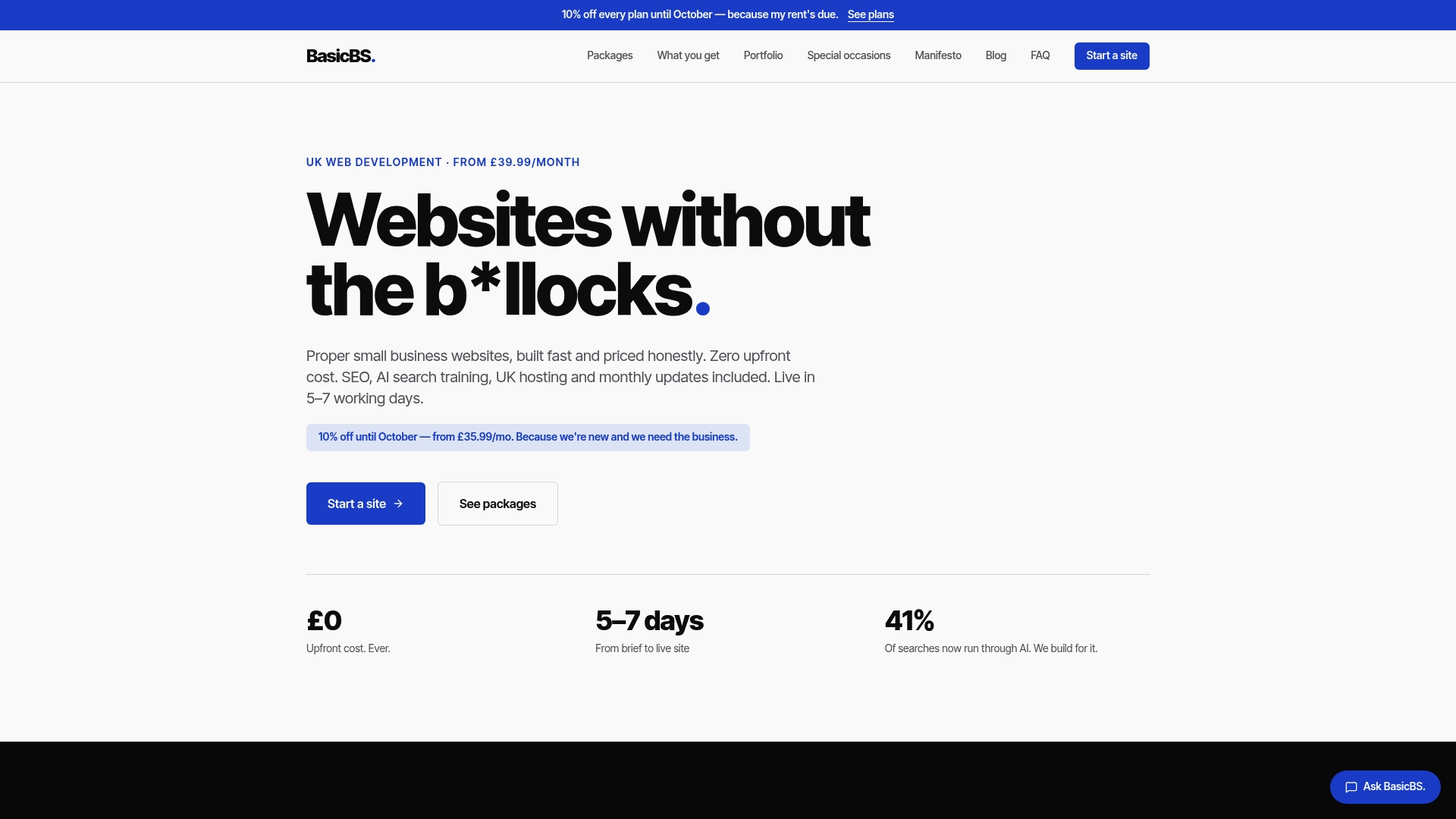
If you’ve read this far, you already know the two things that make or break a build timeline: readiness and pricing clarity. BasicBS handles both. There’s website design no upfront cost UK sole traders keep asking about, with the Website Sale plan from £10 per month, no long-term lock-in, and a 35% loyalty discount once your first 12 months are up. It’s genuinely website design without monthly contract anxiety, since cancellation may be possible after an initial period.
Whether you’re seeking web design for electricians, plumber website design packages, a website builder for builders and joiners, or a landing page for checkatrade alternative searches, the approach is the same: fast build, honest pricing, no nonsense. Sole traders get a simple website setup with a mobile friendly quote page for trades built in from day one. Every site also comes with AI search training, so if you’ve been wondering how to get my business on ChatGPT search, that’s covered as part of the build, alongside SEMrush-led SEO and local business schema setup UK sites need for google AI overview optimization small business owners are chasing right now.
Planning a wedding, baby shower, or big birthday? BasicBS also builds bespoke one-page event sites from £99.99. Whether you’re after cheap website maintenance for trades, affordable web design for sole traders, or you’re simply searching web design Burnley and Pendle way, browse the portfolio or check the full service breakdown and get a quote today.
Where can you check the official rules for accessibility and cookies?
Two government sources are worth bookmarking before your build starts, not after it launches. GOV.UK’s accessibility guidance sets out how to integrate WCAG 2.2 AA standards and publish a valid accessibility statement. The ICO’s cookie and PECR guidance explains exactly what counts as a non-essential cookie and how consent needs to work. Both are free, both are authoritative, and both are far cheaper to read now than to fix retroactively after launch.
Sources
- Gov
- Cookies and similar technologies — ICO
- How Long Does it Take to Build a Website in 2026? — Elementor
- Web design best practices for UK business (Cloudswitched)
FAQ
What is the typical timeline for creating a website?
Most small-business websites take 4 to 10 weeks from kickoff to launch, depending on complexity, content readiness, and how quickly feedback comes back at each stage. A simple brochure site can launch faster, while industry estimates put more complex builds well beyond 8 weeks.
How long does it normally take to build a website?
It depends heavily on project type: a template site with 5 to 10 pages often takes 3 to 5 weeks, while a custom SME website typically runs 6 to 10 weeks and e-commerce builds run longer still. Ready content and a single decision-maker for approvals are the two biggest levers for speeding things up.
What are the 7 stages of web development?
Definitions vary slightly across the industry, but most break the process into discovery, planning, design, content preparation, development, testing/QA, and launch, sometimes with a separate maintenance stage after go-live. This article groups several of those into five practical phases: discovery, design, development, content and SEO, and testing through to launch.
Is web design still worth it in 2026?
Yes. A properly built site remains the one online asset a small business fully controls, unlike a listing on a third-party directory that can change its rules or pricing at any time. With pay monthly website design UK options like BasicBS’s Website Sale plan, the upfront cost barrier that used to make this a hard call for sole traders has largely disappeared.
What causes the most delays in a website build?
Missing or incomplete content, such as photos, service copy, and policy pages, is the most common cause of delay, closely followed by slow client sign-off. Preparing a complete content pack before kickoff and naming one decision-maker for approvals removes both problems before they start.